
You've probably come across this blog because you typed something in your search bar resembling "how to declutter memorabilia and keepsakes." Memorabilia is physical proof of experiences and memories, of who you used to be. How in the world are you supposed to declutter something so personal, so interwoven into yourself?
Well, let me start with a counter-question: What's your goal here? Do you need more physical room at your house for items used in your current life? Or are you coming to this emotionally, needing to finally put down a burden or lay something to rest?
If you truly have room in your house to store all of your keepsake items (this does NOT include storage units. Storage units are not allowed.), then skip to the final section for some tips on how to store your items more efficiently or how to integrate them into your current lifestyle. If your spaces are overfull and you are the kind of sentimentalist who needs guidance in figuring out what to keep, or the kind who just needs some emotional support, this article is for you.
We'll start with some ground rules to keep us trucking in the right direction.
ground rules
First and foremost, we know this is a vulnerable and deeply personal topic. What you will not find in the following paragraphs is finger-wagging, stern talking-tos, or judgy eyes. This is simply meant to be a starting place and a guide for when you're ready to begin this journey. Be sympathetic towards yourself, and don't pressure yourself to get it all done immediately. These are YOUR memories and YOUR heart. Guard them with grace.
Secondly, if while you're going through your things and you start to feel intense emotions, permit yourself to step away and process them. Grieve or laugh as needed, drink some water, and make a bowl of emotional support nachos.
If you find yourself thinking "Oh, I had forgotten about this...," take it as an indicator. The brain is an incredible organ, not yet fully understood, but we do know that it stores important things, novel things, and repeated things. Trust that your brain will remember the most momentous, influential, cherished, and powerful events from your life. And memories are worth the rent; your stuff, on the other hand, might not be.
Finally, decide ahead of time how much you're going to keep and adhere to your own rule. Be honest with yourself about how much space you have, and pre-decide on either 1) a certain number of items or 2) an amount of space that your keepsakes must fit into.

how to decide what to keep
A lot of these questions are similar to ones we'd ask if we were helping you declutter any other space in your home. Some of them are simply variants of each other, but one variation might convict you in a way another might not. Peruse these:
How often do you actually come back and look at these things, relive these memories? If you're not in the habit already, how often do you foresee yourself doing it in the future, if at all?
What kind of memories are associated with these items? If positive, consider keeping them; If neutral, consider whether the item is a joy or a burden, and if it serves you at this point in your life; If negative, then let them go. Ain't nobody got time to hang onto millstone memories. You deserve freedom.
Does this item represent your memory or someone else's? If the latter, then why is it in YOUR possession?
To help you discern about the stuff in the neutral-feeling category: What's the worst that could happen if you got rid of it? Is it worth the space it's taking up? Would you pay to move it? Would you pay full-price for it today? How would you feel if it were lost in a fire?
And the hard stuff: Could you actively use it in your day-to-day? Does it fit your lifestyle right now? Does it help you live the life you want to live, be the person you want to be? Is this something you're proud is part of your story? Is it something worth sharing with your kids? Is holding on to this past hindering you from embracing the present?
And last but not least, the practical: Do you have room for it? (But for real, this should honestly be question number one.)
Most of it (like with any other category we declutter) comes down to this: Is it serving you and/or does it bring you joy? If the answer is "yes" to one or both, by all means hang on to the item. If the answer to both is "no," friend, your physical and mental capacity is better spent elsewhere.
categories and tips
Artwork: What I'm about to say might ruffle some feathers, but here goes: Every piece of paper that your child brings home from school is not a priceless piece of fine art. There, I said it. I'm not saying nothing is worth keeping, but also, not everything is worth keeping either. There is a middle ground that allows you to keep the most special pieces as a representative of your child's obvious creative genius. See the section below titled "Organizing Solutions" for some tips for this category.
Papers and written documents: I'm old enough that I've had a couple of pen pals, and those letters are special to me. I'm also a big journal-er; I've written in a diary for as long as I can remember. But, as I stated above with art, not all papers are created equal. Aim again for the middle ground that includes special, representative items, and recycle the rest.
Furniture: Of all the categories, this one is likeliest to have attached feelings of "what if I need this someday?" Only you can answer that question, but there are a few things to consider to help with the decision. How long have you kept the item and NOT needed it? Could a family member or friend make use of it? If it's an antique, how much work or restoration would it need in order to fit into your current lifestyle, and would it be worth the cost?
Clothes: Clothing seems to hold particular value, be it a child's first onesie or a grandmother's quilted jacket. And it's hard to part with something so practical--the jacket is still wearable, and the onesies can be saved for grandkids. But we can be selective about what gets to take up space in our lives now.
I've kept a few of my Granddaddy's cardigans and sweater vests. The cardigans make great house-robes, and the vests make me feel scholarly, like him (he was a university professor). I can't tell you how many times I've worn the vests with leggings and boots and received compliments, and how pleased it made me to say, "Thanks! It was my Granddad's." Even split among several family members, however, we could never wear his entire wardrobe. Most of his pieces were donated to a local church's clothing bank. And the best part is, I know that's what he would have wanted.
Books: I'll be honest, books are a hard category for me. They're multi-functional! They are decor, entertainment, continuing education, self-help, and memorabilia. However, I am learning to be honest with myself regarding which books on my shelf that I've outgrown. And, as much as I love books, I don't need Granddaddy's entire collection of Zane Grey and Louis L'Amour novels to remember that he loved Westerns. I've got that seared into my memory because of the countless times we visited their house. When we arrived, he would always be in his favorite armchair either reading or cheering for John Wayne on the TV.
Knick-knacks and sets: The thing about collections is...it's actually ok to separate them! If you have an entire 3-box set of Aunt Carol's china or Uncle Herbert's tools, consider keeping just one item or a small assortment as representation of the whole collection.
Awards and trophies: Of course you are proud of those accomplishments, but third grade soccer participation probably didn't change the course of your life. Keep a photo of little you in your jersey instead.
a note on photos and papers
I remember the days of film cameras. I remember taking film to the drug store, and waiting a week or so to have it developed. I remember flipping through the glossy photos, hoping they turned out the way I wanted them to, hoping they captured the moment in stillness the way it played back in my head. And I remember there being about 1 in 5 that actually captured something memory-worthy.
All this to say: photos are obviously important, and always will be. But maybe we can let ourselves pick the best ones and let the rest go (I'm looking at you, husband of mine, who wants to save all twenty new photos of our new kitten each time she does something cute even though they are literally ALL THE SAME)(as said kitten is currently curled at my feet and I absentmindedly reach for my phone and open the camera...).
Going through photos and paperwork is a PROCESS. It requires time and patience, an entire dining room table, and usually some wine. This could be a blog in itself, and we encourage you not to start here. Start with a category that you believe will be easier, either on your time or on your heart, and get that accomplishment under your belt.
pushbacks and obstacles
I promise, at one point or another, I've had the same pushbacks that you have. Let's see if we can come to some helpful compromises.
If you're carrying any guilt over an item's value: Have someone professional appraise it to confirm or deny your what you think it's worth.
If you're saving it to give to your kids, grandkids, or friends: Pick up the phone right now and ask them if they want it! That could take it off your hands sooner than you thought.
If you're worried about insulting anyone: Once the item is in your possession--once it's been given to YOU to store and be responsible for--it's now yours to do with as you see fit. If you think it would help smooth things over, have a conversation with the other parties "involved" before you take any action.
If you're worried about forgetting the memory: Friend, you're not going to forget what's truly important and those experiences that shaped who you are.
If you're worried over potentially needing it in the future: 9 times out of 10, you won't.
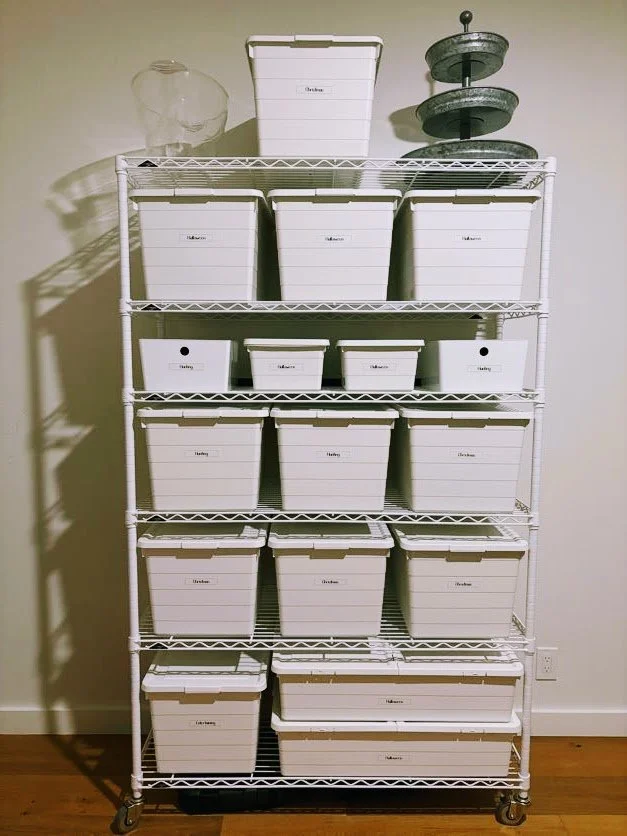
organizing solutions
Frame it: Somewhere in your home, keep a bin for each child for the papers they bring home during an entire school year. Make it a summer project to go through the previous year's papers and decide what to keep. (Whitney offers personalized keepsake boxes for this very thing, and you can find more info here!) Alternatively, use frames like this one to display your child's art in real time, easily replacing each new masterpiece.
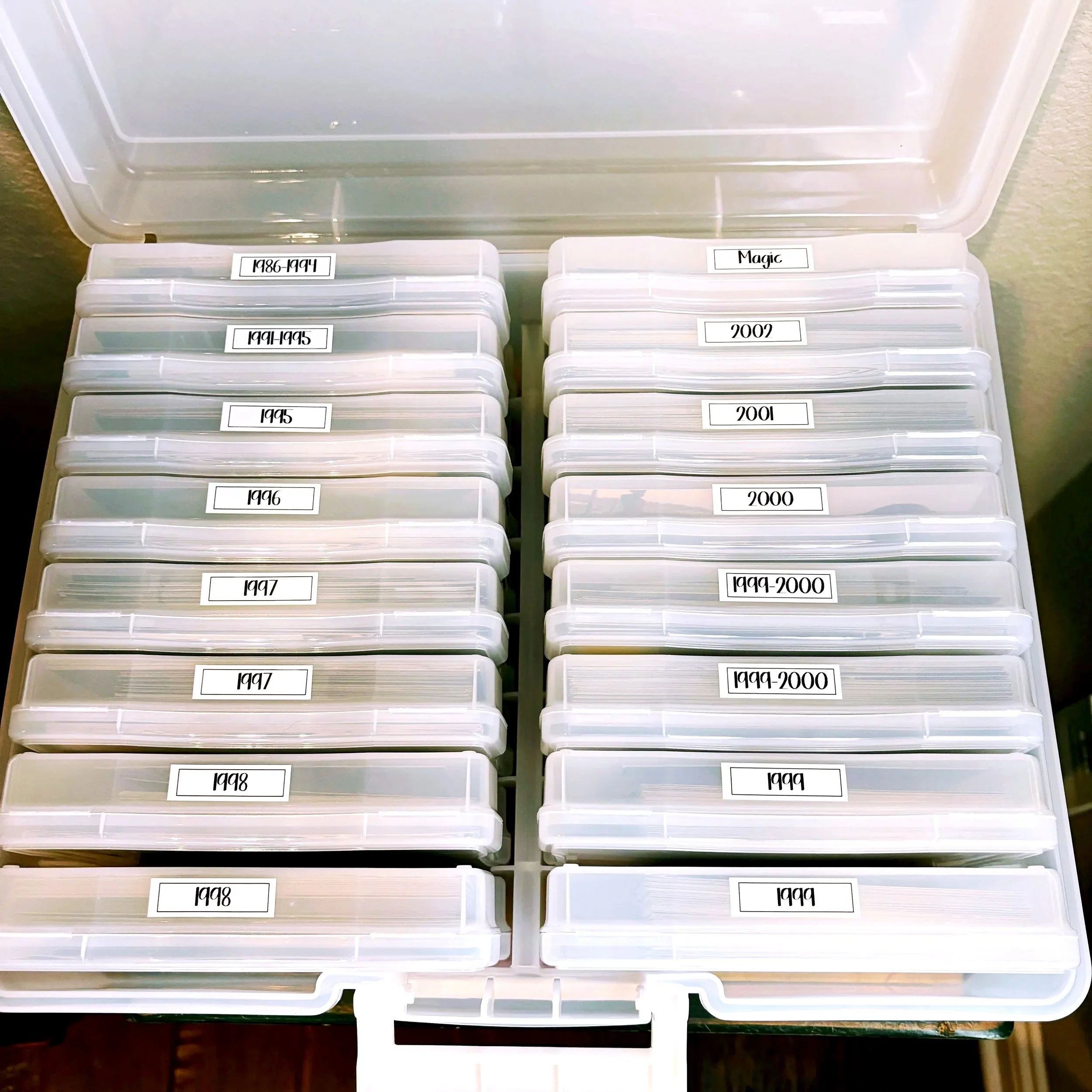
Archive it: Special archival boxes (like these!) are made from materials that minimize dust, dirt, and sunlight to severely minimize deterioration, especially for papers and photos. And don’t forget acid-free tissue paper for cushioning all your fragile items!
Timeline it: Organize your items by category or timeframe (by year or school year, by decade, by the years you lived in a certain city, etc.).
Compact it: Use small, manageable boxes. Small items are typically fragile, and tend to get lost or damaged in large bins.
Weather-proof it: If you've decided it's worth keeping, you would probably be very upset if rain or bugs were to ruin it. Be mindful of items that need to be stored in a temperature controlled environment as well.
Repurpose it: There are few things in this world that truly only have one use. Maybe you're expecting a baby and that roll-top desk collecting sawdust in the garage could be modified into a changing table. Or you're uncle's old pocket-knife that is now dull could be your office letter-opener. Raid the internet or Pinterest for ideas and get crafty!
Digitize it: Take photos of items and keep them in a specific folder on your computer. You could also employ a service like this one that will organize and digitize your collection for you, and even make it into a memory book.
Display it: If an item you want to keep isn't necessarily or immediately useful, intentionally showing it off is an easy and classy way to honor an event or a person. My mom has a shadow box with a handful of my Granddaddy's things--pins and pens from his professorship, a couple of colorful lures from his tackle box, a leather bookmark with his initials, and small print-outs of his favorite Bible verses. Having them arranged and displayed is such a sweet reminder of his presence, much more so than keeping those items hidden away in the attic.
Whatever you keep, commit to looking at it yearly to reevaluate your attachment. Maybe you do this in December or January as part of a seasonal transition. Maybe you do this on your birthday as an exercise in gratitude. Lots can happen in a year, and maybe what's important to you has changed or shifted. Give yourself permission to change, and let your possessions follow suit.
I'm not saying you should get rid of all your stuff. Our stuff is a reflection of who we are. I'm holding on to textbooks from the year I spent obtaining my master's degree. My life and career path have pivoted since I earned that degree, but I worked darn hard that year, and it certainly shaped me as a person. Those books are a representation of what I learned--not just about the topic, but about myself.
What I AM saying is that it's prudent to be selective. Physically, we only have so much closet space in our homes (again, no storage units allowed!). Emotionally, there is a fine line between cherishing/respecting your past and getting stuck there. Being judicious about memorabilia will shape how we see our past, which in turn shapes how we act in the present and how we look forward to the future.